
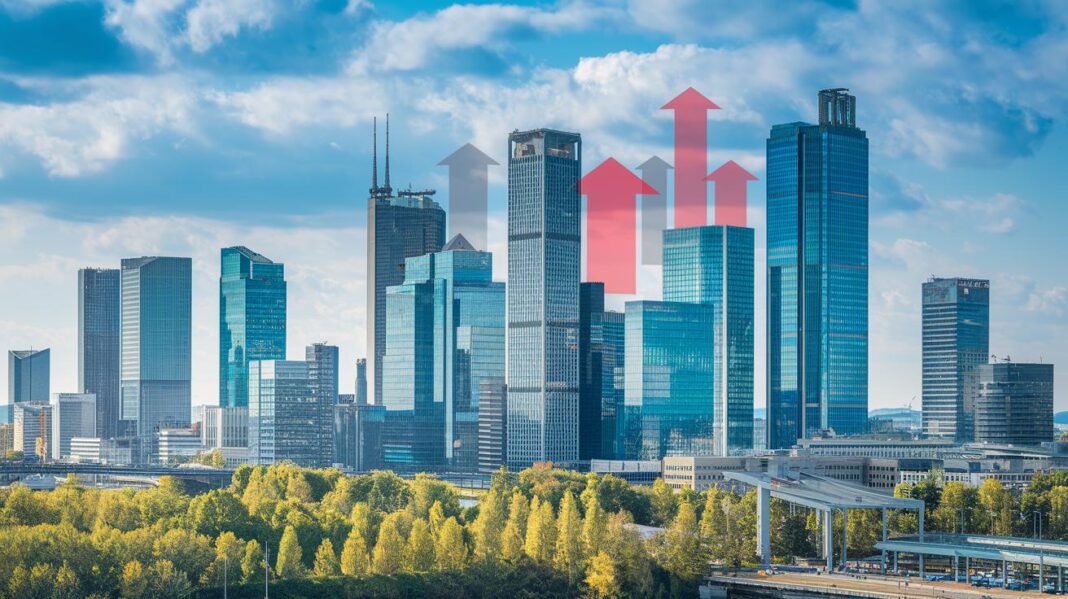

Germany Economy Shows Recovery Signs
Data shows a boost in business activity and hints at steady recovery, with analysts expecting GDP to reach around $5,014 billion in 2025.
• Business activity rises after years of stagnation.
• Analysts project GDP of $5,014 billion in 2025.
• Even a 1% growth this year boosts investor confidence.
After years of slow growth, new figures reveal increased business activity in Germany. While this year's 1% growth may seem small, every gain matters, offering investors renewed hope for ongoing improvement in the coming quarters.
gdp growth in germany: upbeat economic surge
Germany’s economy is showing signs of recovery. Analysts now expect its GDP to hit about $5,014 billion in 2025, keeping it as Europe’s largest and the world’s third-biggest economy behind the U.S. and China.
• Q4 2025 ended a five-year period of stagnation.
• Only two quarters of growth were seen in the past three years.
• Forecasts now point to around 1% GDP growth for this year.
• Investors will watch next-quarter data to gauge if the recovery continues.
The rebound, which began in Q4 2025, marks a key shift from years of slow growth. Although we saw minimal progress before, this turnaround is a sign that economic activity is picking up. However, with forecasts showing just 1% growth for this year, the recovery’s strength will depend on more consistent quarterly improvement. Investors are keeping a close eye on new data to see if this upward trend holds.
Historical Progress of German GDP Growth

Germany's recent stagnation stems from low business confidence and rising insolvencies, which have left investors uneasy during a prolonged crisis.
• Weak sentiment and insolvency issues led to inconsistent growth signals.
In Q4 2025, industrial orders rose for three consecutive months, indicating an uptick in business activity and hinting at a gradual recovery.
• Three straight months of higher orders boosted recovery signals while building on earlier gains.
Yet, ongoing structural challenges like a fragile private sector and persistent insolvency issues continue to weigh on medium-term growth prospects.
• Lasting improvement will require fundamental economic reforms.
Sector Dynamics Affecting Germany’s GDP Growth
Germany’s service sector powers the economy, making up 70% of its GDP. Industrial orders have risen for three consecutive months ahead of Q4 2025, restoring investor confidence. In Q3 2025, renewables generated 64.1% of domestic electricity, marking clear progress in sustainable energy. Meanwhile, November 2025 exports reached €128.1bn, though they fell 2.5% month-over-month and 0.8% year-over-year, indicating slight short-term weakness.
- Service accounts for 70% of GDP.
- Industrial orders climbed for three straight months.
- Renewables provided 64.1% of Q3 2025’s power.
- Exports dipped 2.5% MoM and 0.8% YoY in November 2025.
These numbers highlight an economy with strong service and industrial segments, but export challenges remain. Investors should watch for continued improvements in renewables and industrial trends as Germany’s economic landscape adjusts.
Key Drivers and Headwinds of German GDP Growth

Despite a modest boost in industrial activity, consumer spending remains low, slowing broader economic improvement.
• Industrial activity shows slight gains, but household spending lags.
• Lower inflation (1.8% YoY in December 2025) helps ease price pressures amid global trade concerns.
• A rise in unemployment and growing corporate insolvencies add further pressure on economic growth.
German private consumption is still weak even though industries have recently picked up. Consumers are hesitant to spend, and domestic investment is feeling the drag as a result. While a modest surge in industry might offer hope, it hasn’t translated into increased household spending.
Inflation has eased from 2.4% in September to 1.8% in December 2025, which offers some relief. However, ongoing trade uncertainties and global economic pressures mean that recovery could still face complications.
On top of that, labor and corporate issues are weighing on growth. Unemployment rose by 23,000 in December 2025 to reach 6.2%. Increased corporate insolvencies and poor business sentiment are further dampening investment, making this a key area for investors to watch closely.
Outlook and Forecasts for GDP Growth in Germany
Germany’s economy is set to grow roughly 1% this year as fiscal spending boosts industrial orders. Still, weak private consumption and rising corporate insolvencies pose challenges to long-term growth.
• Fiscal spending is pushing industrial activity.
• Private consumption remains an area of concern.
• Structural issues, like corporate insolvencies, may slow momentum.
2024 GDP Forecast
Estimates for 2024 point to a steady 1% GDP growth, largely fueled by renewed industrial effort from targeted government spending. This short-term boost works much like a small business receiving a crucial cash infusion, supporting sectors dependent on public contracts.
• Targeted fiscal measures are expected to sustain industrial orders.
• The short-term boost is limited by ongoing structural challenges.
2025 Growth Projections
Looking ahead to 2025, growth will depend on improvements in private consumption and the success of structural reforms. A rebound in household spending could lift the economy, but if issues like consumer hesitancy and rising insolvencies persist, growth may remain modest.
• A recovery in private consumption could drive stronger growth.
• Continued structural issues might keep GDP growth at around 1%.
• Policy adjustments will be key to a healthier outlook.
Resilience Factors and Challenges in Germany’s GDP Growth

Germany’s Q4 2025 rebound is driven by updated fiscal policies and focused industrial investments. This shift boosted industrial orders and diversified the energy mix, even as high insolvency rates and weak private spending drag on overall growth.
- Industrial orders increased for three straight months as new fiscal measures restored business confidence.
- Renewables produced 64.1% of Q3 2025 electricity, cutting reliance on traditional fuels.
- Grid electricity output grew 2% year-over-year, with government spending fueling key investments.
- Ongoing insolvency issues and poor private consumption continue to challenge GDP growth.
Policy changes and targeted investments are reshaping recovery trends, so investors should watch these underlying pressures closely.
Final Words
in the action, we covered Germany’s economic journey from a prolonged stagnation phase to renewed momentum. We traced the recovery through recent industrial orders, sector splits, and forecast odds that offer a clearer picture of market activity.
• Industrial orders picked up, indicating renewed demand.
• Forecast models project around 1% growth this year.
• Structural issues still challenge the rebound.
The insights on gdp growth in germany emphasize a cautious yet positive outlook as opportunities emerge amid ongoing market shifts.
FAQ
What were the GDP growth trends in Germany for recent years and what is expected for 2025?
The GDP growth in Germany shows modest increases, with earlier data from 2021 and 2022 nominal compared to the 2025 forecast of about 1% growth and an estimated GDP of USD 5,014 billion.
What information do Germany GDP growth charts and graphs provide?
Germany GDP growth charts and graphs illustrate trends over the past 10 to 20 years, highlighting periods of stagnation, a recent rebound starting in Q4 2025, and gradual recovery in economic performance.
Is Germany’s GDP currently growing?
Germany’s GDP is growing modestly as it recovers from a five-year stagnation, indicated by industrial order increases and slight growth over recent quarters despite ongoing structural challenges.
How does Germany compare to the USA in overall GDP rankings?
While Germany is the largest economy in Europe and the world’s third-largest by GDP, the USA remains richer, holding the top spot in global GDP rankings.
Why is Germany’s GDP considered high?
Germany’s high GDP is driven by a robust manufacturing base, a dominant service sector, strong export performance, and fiscal policies that have supported industrial orders and economic activity.