

China GDP 2025: 5.0% Growth Shows Mixed Signals
China’s economy grew 5.0% in 2025, raising questions about whether this marks lasting strength or just a temporary burst amid shifting trends.
• Quarterly growth fell from 5.4% to 4.5%.
• Industrial gains helped boost numbers despite tepid consumer spending.
• Global shifts and changing domestic trends add complexity to performance.
The slowdown in quarterly growth highlights that the high overall number isn’t the full story. Industrial gains and cautious consumer behavior now combine to drive the momentum. Investors and market watchers should note these mixed signals as they gauge China’s economic outlook.
China GDP Growth: 2025 Performance Overview
China’s GDP grew 5.0% in 2025, reaching RMB 140.2 trillion (US$19.6 trillion) as the economy maintained steady growth amid shifting domestic and global conditions.
• Q1 growth reached 5.4%, then slowed to 5.1% in Q2, 4.8% in Q3, and 4.5% in Q4.
• Total goods trade increased by 3.8% to RMB 45.4687 trillion, with exports up 6.1% and imports rising 0.5%.
• Fixed asset investment fell 3.8%, with real estate investment dropping over 17%.
• Trade and industrial performance helped support growth despite weaker domestic stimulus.
The figures show that China met its growth targets while managing evolving market challenges and cautious investor sentiment.
China GDP Growth Momentum: Quarterly Trends in 2025

China’s growth decelerated in 2025, with quarterly GDP rates dropping steadily. The data shows Q1 at 5.4%, Q2 at 5.1%, Q3 at 4.8%, and Q4 at 4.5%.
Key takeaways:
- The decline suggests early fiscal stimulus is losing its impact.
- Domestic spending has become more cautious, notably in sectors reliant on local consumption.
- Moving forward, policymakers may opt for targeted measures instead of broad stimulus packages.
| Quarter | Growth Rate |
|---|---|
| Q1 | 5.4% |
| Q2 | 5.1% |
| Q3 | 4.8% |
| Q4 | 4.5% |
An analyst commented, "Early fiscal measures drove the initial momentum, but the recent trend points to a shift toward industry-specific interventions."
China GDP Growth Drivers: Industry, Consumption, Investment, Trade
China’s GDP grew 5.0% in 2025, driven by four main factors: industry, consumer spending, fixed asset investment, and foreign trade.
• Industrial output rose 5.9% year-on-year with high-tech manufacturing increasing over 9%
• Retail sales climbed 3.7% to RMB 5.01 trillion, while modern services grew near double-digit rates
• Fixed asset investment fell 3.8%, with real estate investment dropping over 17% amid a deleveraging trend
• Overall goods trade increased 3.8%, boosted by exports up 6.1% and imports by 0.5%
Industrial production remains a key growth engine, with technical innovation fueling both domestic demand and exports. Meanwhile, consumer trends favor digital and service-based spending, which helps offset slower traditional retail growth. Although property investment declined sharply, a steady increase in foreign trade underlines a balanced, cautious economic recovery amid global market challenges.
China GDP Growth Sectoral Breakdown: Industry, Services, Clean Energy
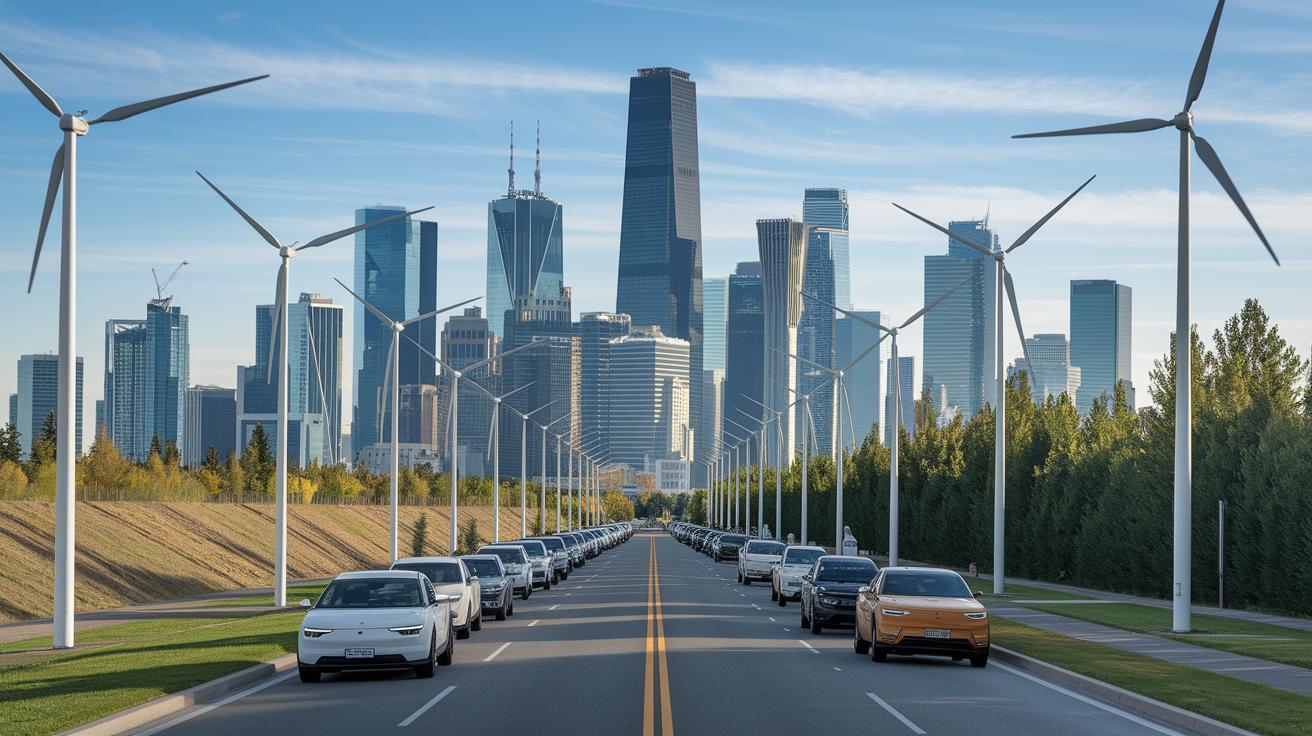
China's GDP in 2025 shows a clear shift as clean energy and modern services drive growth, while traditional manufacturing stays vital. One major point: clean energy now contributes over 33% of total GDP growth.
• Clean energy leads with over 33% contribution.
• EV and battery tech drive 44% of the clean energy impact.
• Modern IT and business services grow near double digits.
• Energy-efficiency turnover rises 17%, mirroring past innovation cycles.
The numbers indicate a strategic move toward sustainable manufacturing and energy efficiency. Electric vehicles and battery innovations are not only boosting industrial performance but also supporting larger infrastructure investments. At the same time, the rise in modern services reflects strong consumer demand and tech adoption that keep the economy on track.
| Sector | Contribution/Growth |
|---|---|
| Clean Energy (overall) | Over 33% |
| EVs & Batteries | 44% of clean-energy impact |
| Solar Power | 19% |
| Transmission & Storage | 6% |
| Rail Transport | 12% |
| Modern Services | Near double-digits |
Policy Impact on China GDP Growth: Five-Year Plan and Reforms
China’s 15th Five-Year Plan is steering the economy toward steady growth with a focus on boosting domestic demand, advancing industrial upgrades, and managing risks in real estate and local debt. The government is shifting from broad fiscal stimulus to targeted actions that prioritize efficient, sustainable progress.
• Growth now rests on precise fiscal and regulatory tools rather than sweeping stimulus.
• Key reforms aim to modernize China’s operating framework and enhance productivity.
• Measures include tight monetary policy focused on maintaining liquidity in crucial sectors and mitigating property market risks.
• Revising local government finance is central to reducing debt risks and encouraging both private and state investments.
These focused initiatives are designed to stabilize the economy amid evolving market conditions and external pressures, promoting long-term stability and improved output efficiency.
China GDP Growth in Global Context: Comparison with US and Peers

China’s reported GDP growth depends heavily on how it’s measured, which complicates comparisons with the US and other nations.
- Price-based metrics like PPP can understate growth because they may miss production efficiency gains.
- Market exchange rates, on the other hand, might overstate growth in economies with stable currencies.
- Adjusting for efficiency is key, as expert measures that factor in exchange-rate swings and policy shifts tend to provide a clearer picture.
Traditional methods have their pitfalls. PPP figures may not capture all of China’s production improvements, while market-based metrics reflect real-time price changes that can distort the story. This difference means each method can lead to varying views on economic scale and performance. Analysts believe that using efficiency-adjusted measures can better account for these biases, leading to more accurate comparisons of China’s global economic stature with that of the United States and its peers.
Projected China GDP Growth: Forecasts and Risk Factors
China aims for a near 5% GDP growth after 2025 by boosting industrial upgrades and demand stimulus. Measured fiscal policies and investments in modern infrastructure support this steady outlook. Analysts believe that advances in technology and service innovation will help reach these targets, even with global supply chain issues and market uncertainty.
• Growth target is near 5% post-2025.
• Fiscal support and infrastructure investments are key.
• Innovations in tech and services bolster the outlook.
• Risks include shifts in the property sector, demographic headwinds, soft external demand, and inflation swings.
Quality growth depends on more than just meeting a number. It requires improvements in productivity, innovation, and sustainability. Policymakers must keep a close eye on fiscal strategies and ensure that monetary tools remain flexible to handle potential market volatility.
Final Words
In the action, the analysis unraveled China’s 2025 performance with a 5.0% growth rate and a GDP of RMB 140.2 trillion. It reviewed how quarterly trends moderated from 5.4% to 4.5% and highlighted robust trade figures.
We examined key market drivers, from industrial output and consumer spending to investment shifts and property-sector challenges that impacted overall performance.
Focusing on china gdp growth, this clear breakdown sharpens actionable insights and reinforces confidence in making rapid, tradeable decisions.
FAQ
What is China’s GDP growth history and how is it displayed in charts?
China’s GDP growth history reflects annual output changes over time. Charts visually track these trends, highlighting significant shifts and aiding investors in assessing long-term economic patterns.
How do China’s GDP growth rates compare over different periods like the last 10, 30, and 5 years?
China’s GDP growth rates vary by period. Evaluating the last 5, 10, and 30 years provides clarity on recent shifts versus long-term trends, helping market participants gauge overall economic stability.
What does monthly data reveal about China’s GDP growth?
Monthly GDP figures provide insight into short-term economic performance, revealing seasonal trends and the immediate impact of policy adjustments, which assists investors in tracking rapid market changes.
How do India’s and China’s GDP growth rates compare?
India and China’s GDP growth rates differ due to economic structures and market dynamics. Comparing these rates helps investors understand each country’s growth momentum and potential market opportunities.