


Carry Trade Strategy: Earn Steady Profits with Interest Rate Differences
Currency carry trades use low borrowing rates to invest in higher-yielding currencies. This approach generates small daily interest credits that add up over time.
• Traders borrow at low rates and invest at higher ones.
• The Tom-next rollover lets traders capture incremental gains.
• Interest rate differences build into meaningful returns.
Carry Trade Explained Using Currency Pairs: Core Concept and Strategy
Carry trade means borrowing in a currency with low interest and investing in one that pays a higher yield.
• Traders sell the low-yield currency and buy the high-yield one.
• Profit comes from the interest rate gap (for example, borrowing at near zero and investing at 4%).
• The process uses a daily rollover (positions close at 11:00 a.m. German time / 5:00 p.m. EST) that adds interest every day.
This strategy is based on interest rate arbitrage. Traders choose a base currency with minimal rates and a quote currency with substantially higher ones. The Tom-next rollover process automatically applies daily credits to the trader’s account. Even small daily credits can add up to significant gains over time. Currency exchange rates also affect profits because market fluctuations can widen or narrow the yield gap.
Traders calculate the expected rollover credit by comparing the yield differences. Larger interest spreads make this strategy more appealing, especially when rates differ widely.
Mechanism of Interest Rate Differentials in Currency Carry Trade
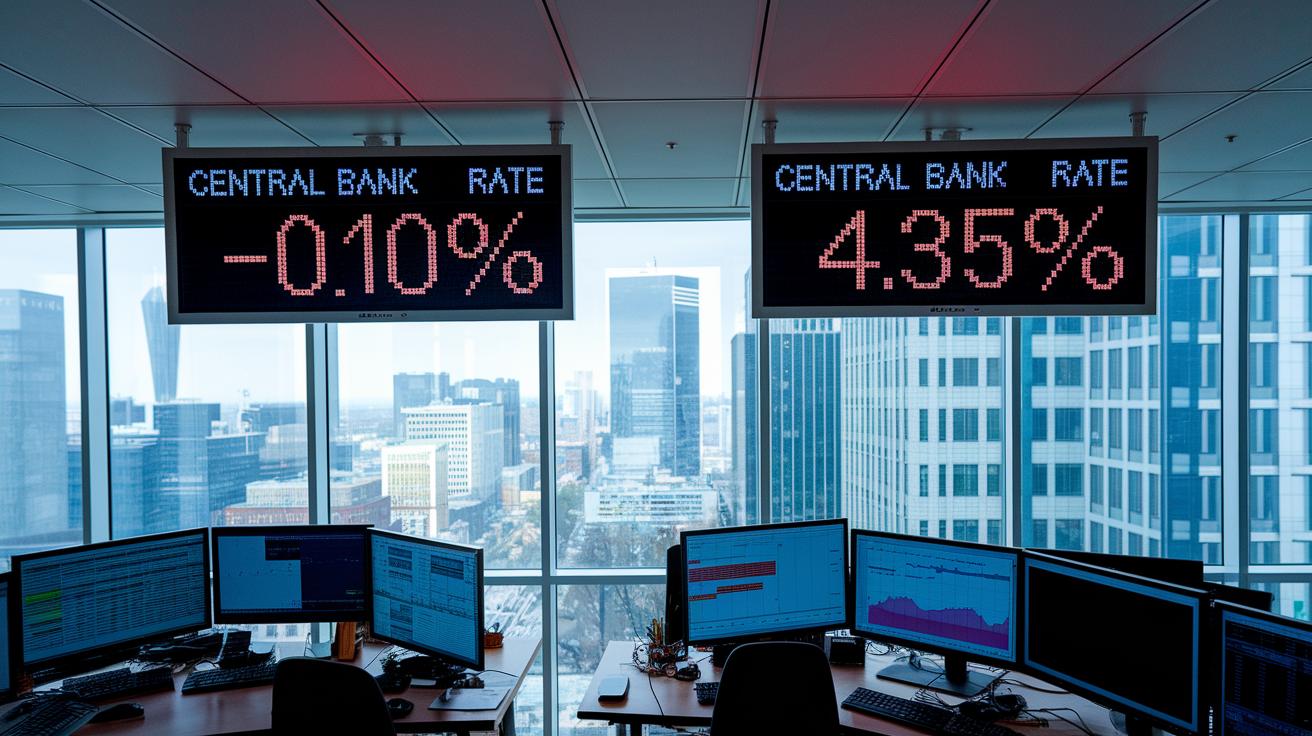
Carry trades start by comparing central bank rates between different currencies. For example, if one rate is -0.10% and another is 4.35%, the annual gap becomes 4.45%, which is then converted into a daily figure.
- Identify two central bank rates: one with a low borrowing rate and the other with a higher rate.
- Calculate the annual yield gap (for instance, 4.45% from -0.10% and 4.35%).
- Divide this annual gap by the number of trading days to find the daily rollover credit.
- Use a Tom-next mechanism: positions close at 11:00 a.m. German time and reopen the next day, automatically adjusting the account.
- Manage FX swings to shield returns from market sentiment and policy changes.
This method provides traders with a clear view of cross-border yield differences and forex spread strategies, covering all key steps in the carry trade calculation without any extra complexity.
carry trade explained using currency pairs: Profits Unfold
A clear example is the AUD/JPY pair. Traders borrow Japanese Yen at -0.10% and invest in the Australian Dollar at 4.35% per year. This setup creates a gap of about 4.45%, which can grow if the Australian Dollar strengthens against the Yen.
• Traders compare these yield gaps to spot attractive opportunities.
• Gains may improve if the funding currency depreciates.
• Monitoring central bank rates helps gauge profit potential.
• Risk controls like stop-loss orders protect against unexpected moves.
Other pairs work similarly. For instance, with NZD/JPY, the New Zealand Dollar earns approximately 4.25% against the same Yen rate, producing a gap of 4.35%. In riskier territory, TRY/JPY shows the Turkish Lira at 9% versus the Yen’s -0.10%, resulting in a 9.10% differential. Meanwhile, the USD/BRL pair offers a funding rate of 2% with a 13% return on the Brazilian Real, forming an 11% gap.
Carry trades not only generate daily rollover income but also act as hedges when market conditions change. Savvy traders use stop-loss orders and proper position sizing to manage risk.
| Currency Pair | Funding Rate | Investment Rate | Annual Differential |
|---|---|---|---|
| AUD/JPY | -0.10% | 4.35% | 4.45% |
| NZD/JPY | -0.10% | 4.25% | 4.35% |
| TRY/JPY | -0.10% | 9.00% | 9.10% |
| USD/BRL | 2.00% | 13.00% | 11.00% |
Risk Factors and Management in Carry Trade with Currency Pairs

Carry trades are exposed to currency swings that can quickly wipe out daily interest credits. A sudden move, like a yen surge after a Bank of Japan rate change, can shrink the profit margin and force traders to re-evaluate their risk premiums.
Unexpected shifts in central bank policies can turn a winning trade into a losing one almost instantly. When rates change unexpectedly, even a small move can lead to significant losses, especially when high leverage is used. Traders must monitor policy announcements in real time to adjust positions before losses build up.
Using stop-loss orders and adjusting position sizes helps limit drawdowns. Setting stop-loss levels based on recent volatility and market support points can protect against rapid FX moves. Keeping an eye on economic calendars and central bank communications is also key for making informed decisions.
- Identify currency pairs with strong interest rate gaps and stable fundamentals.
- Use stop-loss orders and proper position sizing to reduce the risk of sudden losses.
- Stay alert to policy updates that could trigger volatility across global currency pairs.
- Continuously monitor market sentiment with real-time data and charts.
Corporate and Institutional Use of Currency Carry Trade Strategies
Corporate treasurers and CFOs regularly use carry trades to lower funding costs and boost short-term cash returns. They borrow in currencies with lower interest rates and invest in higher-yield options. This approach not only raises immediate yields but also helps hedge against fluctuations in foreign exchange rates.
Institutions build on this strategy by tapping into diverse funding sources and targeted international investments. They often use financial products like ETFs and funds that mirror passive carry strategies. These tools give investors exposure to interest rate differences while reducing risk through built-in diversification and expert management.
Companies also rely on regular risk checks to balance potential gains and losses. They frequently review their foreign exchange and rate exposures and adjust their positions based on central bank signals. This process ensures that benefits from carry trades are not weakened by sudden currency shifts or unexpected changes in rates.
- Leverage low-cost borrowing to boost asset yields.
- Use diversified financial products to manage exposure.
- Conduct regular risk reviews to maintain capital efficiency.
Step-by-Step Guide to Executing a Carry Trade Using Currency Pairs

Start by checking central bank rates to choose a low-cost funding currency and a high-yield target currency. Then, calculate the daily rollover credit by dividing the annual interest rate gap by 252 trading days.
- Compare central bank rates to spot attractive currency pairs.
- Compute the daily rollover: for example, a 4.45% yearly gap divided by 252 equals roughly 0.0177% each day.
- Use platform tools to execute simultaneous FX buy/sell orders that track market changes.
- In volatile markets, set algorithmic stop-loss orders and strict position limits. For instance, create alerts for shifts during the Tom-next rollover (usually at 11:00 a.m. German time).
- Monitor economic policy and market data in real time with your platform’s tools.
Before going live, note that some traders use built-in simulator modes on their platforms to test strategy parameters and adjust risk controls.
Final Words
In the action, we broke down how the carry trade works using currency pairs, from identifying rate differentials to managing risk. We covered the strategy’s mechanics, key examples like AUD/JPY, and the tools institutions use to optimize their positions.
This overview explains the process step-by-step and highlights how the carry trade explained using currency pairs can create tradeable opportunities when executed with careful risk controls. Positive market moves often stem from clear, actionable strategy execution.