

India’s GDP Near 7% Boosts Economic Resilience
India’s real GDP is projected to grow nearly 7% in 2025, driven by strong domestic demand and rising exports amid global trade tensions.
• GDP growth nears 7% in 2025
• Robust domestic demand and rising exports propel progress
• 30 years of stable growth support brighter prospects
• Smart policy moves reinforce momentum despite global slowdown
India continues to build on decades of steady growth. The country’s smart policies and strong export performance are helping it navigate global challenges. With a solid track record spanning more than 30 years, India stands out as a key market for investors and policymakers moving forward.
India GDP Growth: Bright Prospects Ahead
India’s real GDP grew nearly 7% in 2025, driven by strong domestic demand, robust exports, and smart policy moves, even with ongoing global trade tensions.
• GDP climbed close to 7% despite external pressures.
• The country has maintained over 6% annual growth for 30 years, with an over-8% surge from 2021 to 2024.
• India contributed about 17% to global GDP growth in 2024, underlining its role in the world economy.
For three decades, India has posted annual GDP growth above 6%, spiking above 8% post-pandemic between 2021 and 2024. This steady performance shows that economic reforms and proactive strategies helped the country overcome global challenges. With nearly 17% of global GDP growth in 2024, India's strong output and ongoing reforms indicate further expansion that investors and policymakers will closely monitor.
India GDP Growth: Historical Trends and Milestones
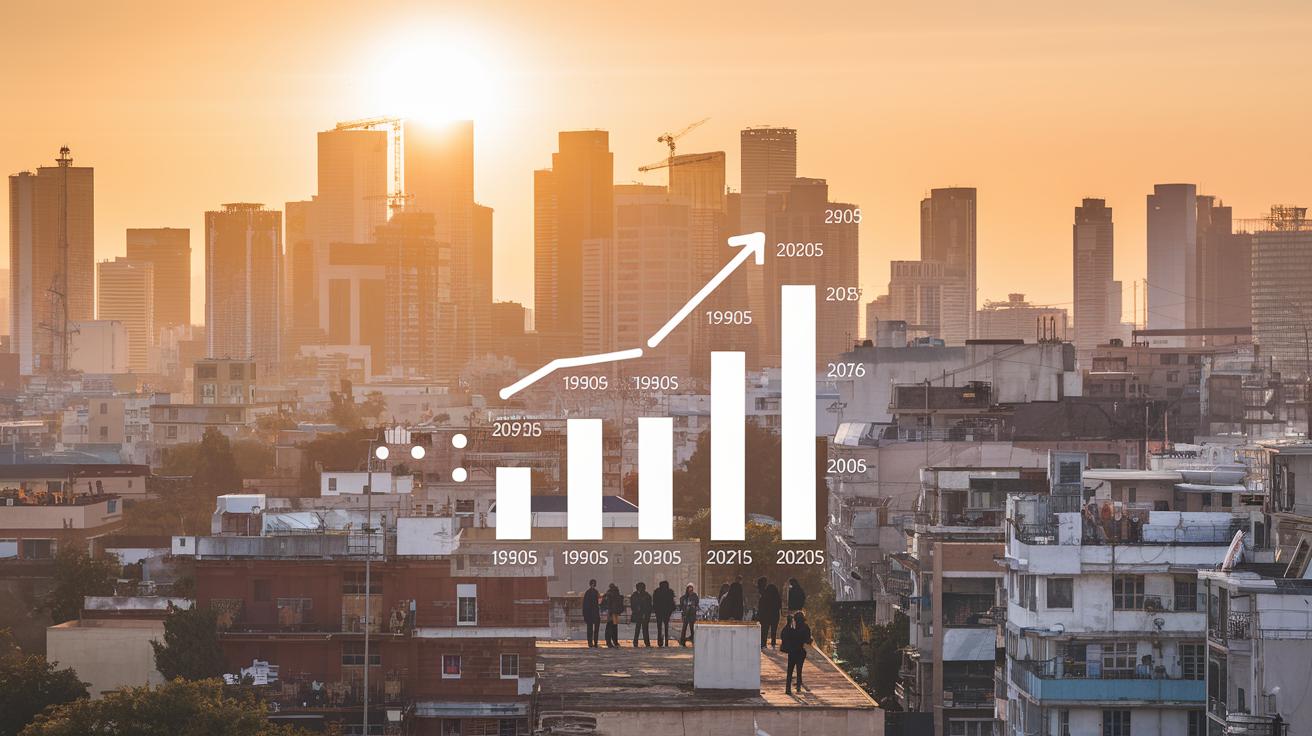
India’s economy has changed a lot over the last 30 years. In the early 1990s, its global GDP share (PPP) was below 3.5% and more than 45% of its people lived in extreme poverty. Since then, economic reforms have spurred growth and boosted living standards. Today, GDP per capita (PPP) is ten times higher, showing a clear improvement in the economic well-being of many Indians.
• GDP per capita (PPP) increased tenfold since the 1990s.
• The country’s global GDP share (PPP) rose from under 3.5% to around 8.3% by 2022.
• Extreme poverty declined dramatically, dropping to about 5% by 2022.
Every decade tells a story. The 1990s set the stage with initial reforms. The 2000s brought steady growth through further structural changes. The 2010s saw significant acceleration in development, raising consumer income and domestic investment. The current decade highlights the success of these steps with strong figures in global GDP share and poverty reduction.
| Period | Key Growth Rate | Milestone |
|---|---|---|
| 1990s | Initial growth | PPP share under 3.5%; extreme poverty over 45% |
| 2000s | Moderate growth | Structural reforms and foundational economic policies |
| 2010s | Acceleration | GDP per capita increased significantly |
| 2020s | Robust boost | PPP share ~8.3% and poverty reduction to ~5% |
India GDP Growth: Sector Contributions Analysis
India's economy now shifts away from traditional farming toward modern services and infrastructure, driving over 60% of national output. This change matters as it skips a heavy industrial phase and focuses on tech, finance, and digital growth.
- Services now power growth with strong tech and finance focus.
- Rural consumption and government spending stabilize demand.
- Exports and steady manufacturing add extra support.
- Infrastructure upgrades boost efficiency and market competitiveness.
India’s strategy centers on expanding its service sector, which now leads the way in economic output. At the same time, consistent rural spending and solid export performance help cushion against global pressures. Upgraded infrastructure improves logistics and supports long-term stability, making it easier for policymakers and investors to gauge the economy’s resilience amidst changing global conditions.
India GDP Growth: Global Ranking and Comparison

India ranks as the fourth-largest economy by purchasing power parity (PPP), trailing only China, the United States, and the European Union. Its share of global PPP has risen from under 3.5% in 1990 to about 8.3% today, a testament to its growing global influence.
• Decades of reforms and market liberalization have boosted India's economic profile.
• Investors and policymakers view this steady rise as a key signal of shifting global dynamics.
• The International Monetary Fund forecasts that India’s role in global GDP could reach nearly 20% in the next five years.
Recent policies have not only improved India's ranking but also set the stage for further growth. With these trends in play, the nation is positioned to play an even bigger role in driving global economic momentum.
India GDP Growth: Future Projections and Forecasts
The International Monetary Fund expects India to drive nearly 20% of global growth by 2029 thanks to key reforms and strategic investments.
- IMF estimates strong domestic momentum.
- Upgraded infrastructure and broader trade are central.
- Policy shifts and investments signal a robust output path.
- The Viksit Bharat plan targets developed status by 2047.
India's future strength hinges on modernizing infrastructure, expanding trade, and boosting human capital. The government's Viksit Bharat plan underlines its commitment to overhaul the economy. Aggressive investments and diversified trade strategies are set to drive output to new highs by 2030. Investors and policymakers are watching these shifts closely as they promise both immediate gains and lasting structural change.
India GDP Growth: Key Drivers and Challenges
India’s GDP growth builds on strong factors. Rural spending is rising, and increased government investment in infrastructure and public services boosts demand. Exports remain steady despite global shifts, and improvements in transport and digital networks help markets run smoothly.
• Rural consumption drives growth as households spend more.
• Higher government spending supports key sectors like infrastructure.
• Stable exports help balance trade amid global uncertainty.
• Upgraded transport and digital connectivity improve market efficiency.
However, challenges could weigh on growth. Growing public debt might limit private investment, and high costs for shifting to renewable energy add pressure. Limited export diversity and ongoing poverty also mean that the benefits of growth aren’t evenly shared.
• Rising public debt risks crowding out private investment.
• Energy transition costs require significant capital and clear policies.
• A narrow export base exposes vulnerabilities in trade.
• Persistent poverty shows that growth benefits are uneven.
Policymakers now face the task of balancing fiscal discipline with necessary reforms in agriculture, education, health, and the judiciary. Managing debt and easing the energy transition while boosting long-term human capital will be key to maintaining robust and inclusive economic expansion.
India GDP Growth: Implications for Investors and Policymakers
India’s strong GDP growth, driven by booming infrastructure, services, and manufacturing, creates clear chances for investors and shapes policymaker agendas.
• Investors see opportunities in diversified sectors fueled by solid domestic demand, government spending, and steady exports.
• Watch shifts in trade, labor, and fiscal policies to adjust portfolios quickly.
• Rising infrastructure investments signal potential boosts in transport and logistics.
• Policymakers must balance reforms with rising public debt to secure stable, long-term growth.
India’s expanding economy opens up practical avenues for asset allocation. Investors should focus on sectors with strong momentum and monitor policy changes that could affect market dynamics. Meanwhile, policymakers are tasked with maintaining macro stability and driving structural reforms in labor, trade, and human capital. Effective fiscal management now can support immediate stability and pave the way for stronger productivity ahead.
Final Words
In the action, our review highlighted india gdp growth trends from headline numbers to sector contributions and historical milestones.
We tracked key growth drivers and challenges shaping market momentum, while linking forecast projections to real trade and policy decisions.
With clear signals across metrics and actionable insights for investors, the path remains promising for smart moves in a dynamic market.
FAQ
What was India’s GDP growth in 2022?
India’s 2022 GDP growth reflects a post-pandemic rebound driven by consumer demand and government spending, marking a positive step in its long-term expansion trajectory.
What does the India GDP growth chart show?
The India GDP growth chart illustrates trends over time, highlighting rising growth rates, key milestones, and shifts in economic performance that provide a clear view of the nation’s expansion.
What has been India’s GDP growth rate over the past 10 and 20 years?
India’s growth rate over the past 10 and 20 years has remained strong, with average annual increases above 6% and a notable acceleration to over 8% in the post-pandemic period.
How is India’s GDP measured in trillion dollars and how does its growth in trillion dollars look?
India’s GDP, often measured in trillions of dollars, shows consistent expansion. The figures underline a growing economy, though comparisons depend on factors such as exchange rates and measurement methods.
What is India’s GDP rank globally and is it among the top five economies?
India’s GDP ranks high on the global stage; by purchasing power parity it is positioned among the top economies, often cited as the fourth-largest, with nominal rankings varying across sources.
Is India’s GDP really growing?
India’s GDP growth is real and measurable, supported by robust domestic consumption, government spending, and increased global contribution, which all underline a steady upward trend.
Is India a 4 trillion economy today?
India’s economy has reached milestones near the 4 trillion mark by some measures, reflecting its large market size, though exact figures depend on the metrics used.
Is India a $5 trillion economy?
India is on a path toward a $5 trillion economy, with sustained growth and structural reforms driving the momentum; however, it has not yet officially crossed that threshold.